Menu pricing psychology: what actually works
Menu pricing psychology without the myths: price formats, menu engineering, anchors and layout, the research behind each tactic and the ones that backfire.
In this article
Menu pricing psychology is the study of how the way you write, place and group prices changes what guests order and spend. The short answer: show prices as plain numbers, sort dishes by margin as well as popularity, keep categories short, and change prices in small, frequent steps. None of this is trickery. It helps guests find the dishes you are proudest of, which are often the ones that earn you the most.
Much of the advice in the trade is folklore dressed up as science. Here is what the research supports, what is simply good practice, and what backfires.
What the research says about menu prices
Three studies are worth knowing by name, because they are quoted constantly and often stretched.
Prices without a currency sign
In a field experiment for the Cornell Center for Hospitality Research, Yang, Kimes and Sessarego (2009) gave restaurant guests the same menu with prices in three formats: a number with a currency sign, the price written out in words, and the number alone. Guests whose menu showed only the number spent more. A common explanation is that a currency sign reminds people they are paying.
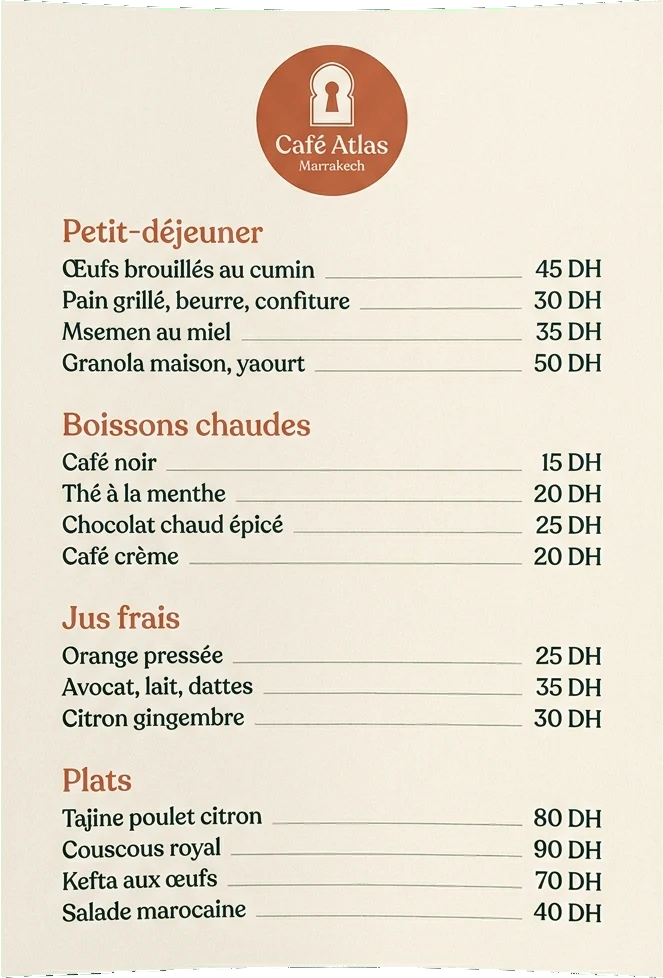
In practice: write 85, not 85 DH. State the currency once on the menu so visitors know what they are reading.
Diners read menus more like a book
Menu designers long repeated the "golden triangle": the eye supposedly lands in the centre, then jumps to the top right and the top left, so that is where high-margin dishes belong. Sybil Yang's eye-tracking study (2012) found something plainer: diners tended to read menus in order, more like a book. The safer conclusion is that the first category and the first lines of each category get the most attention. Put a dish you want to sell there.
Fewer choices per category
Iyengar and Lepper (2000) set up a tasting stand with either 24 or 6 jams. The bigger display drew more people, but shoppers who saw 6 were far more likely to buy. The honest caveat: later replications of this "choice overload" effect have been mixed. Treat 5 to 9 items per category as a working rule, not a law. A pizzeria can list twelve pizzas because guests know the genre; a cocktail bar with 25 drinks in one block will slow every order.
Menu engineering: stars, plowhorses, puzzles and dogs
Menu engineering classifies every dish by two numbers: how often it sells and how much it earns. Kasavana and Smith (1982) set it out as a simple matrix, still the most useful hour a manager can spend with the till report.
For each dish you need the number sold over four weeks and its contribution margin: the selling price without VAT minus the cost of its ingredients. A dish is popular if it sells at least 70% of its fair share: with 10 dishes in a category, the fair share is 10% of sales, so the line sits at 7%. A dish is high margin if it earns more than the category's average margin.
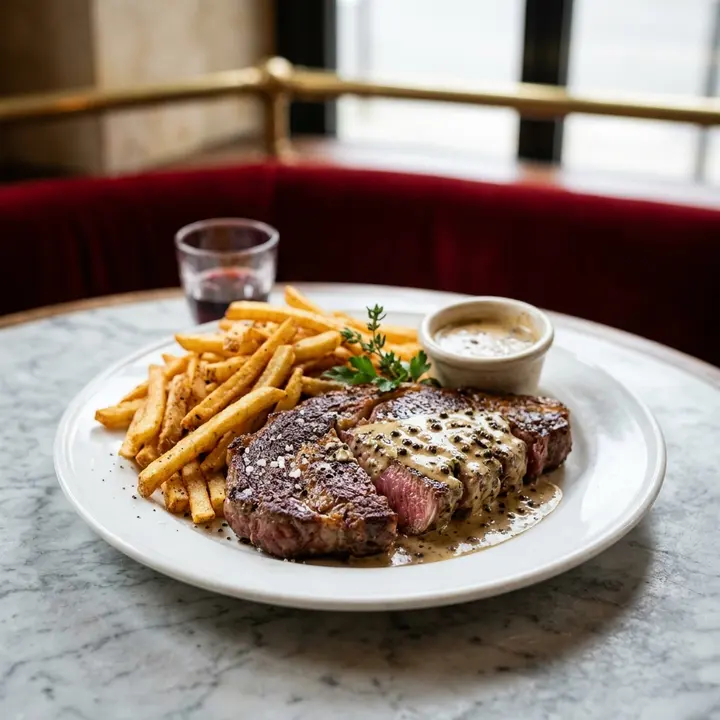
Take a classic bistro menu like our Petit Zinc demo. In many bistros, steak frites is a plowhorse: everyone orders it and beef is expensive. The onion soup is often a puzzle: cheap to make, rarely chosen. The first needs a small price rise or a better-margin side; the second needs a better spot and a line about the slow-cooked onions.
Two cautions. Run the matrix per category: comparing a coffee with a steak tells you nothing. And a dog is not always a mistake. A modest vegetarian dish may be the reason a table of six chooses you.
How to price a menu: practical rules from the floor
These are practitioner rules, not lab findings. Each one is cheap to test.
- No price columns, no dotted leaders. Prices lined up on the right invite guests to scan for the cheapest item. Put the price at the end of the description, in the same type size.
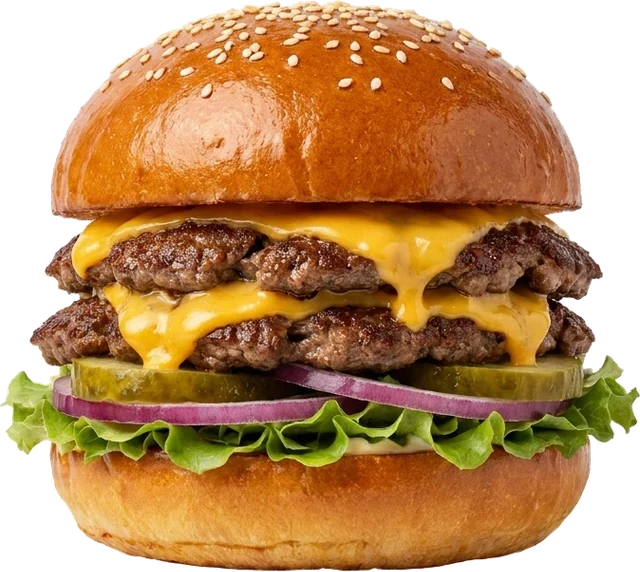
- Use an anchor. One premium item at the top of a category (a côte de boeuf for two, a seafood platter) makes the next one down look reasonable.
- Match the price ending to the venue. Round prices such as 24 or 120 read as confident and suit fine dining and hotels. Casual places can use steps of .50 (8.50, 12.50). Avoid .99: it reads as supermarket.
- Offer sizes and bundles. A glass or a bottle, 200 g or 300 g. A breakfast formula (hot drink, juice, msemen or croissant, eggs) or a burger combo raises the average ticket and speeds up ordering.
- Describe origin and method, not adjectives. "Lamb shoulder slow-cooked for seven hours with preserved lemon" says more than "delicious tender lamb".
- Feature and photograph your best-margin dishes. A photo is the strongest signal on a menu. Spend it on stars and puzzles, not on the dish everyone already orders.
Three pricing tactics that backfire
- Hiding prices. "Market price" on half the menu, or no prices at all, makes guests anxious and pushes them towards the cheapest safe choice.
- Too many decoys. One anchor helps. Three overpriced items per category look like a trick, and regulars notice.
- Prices that change without the menu changing. A guest who reads 45 on the table and pays 50 at the till will remember that, not the meal. Out-of-date menus make honest venues look dishonest.
Pricing a menu when costs keep rising
US menu prices were up 3.4% year on year in June 2026 (National Restaurant Association). The worst response is the big annual reprint where twenty prices jump at once. Guests notice a new menu with every line higher; they rarely notice one dish moving by 2 DH in March and another in May.
A practical rhythm:
- Recalculate the food cost of your ten best sellers every month.
- Move the plowhorses first, in small steps.
- Leave the anchor and the cheapest item of each category alone, so the range still feels fair.
- When a rise is larger, pair it with something visible: a better side, a clearer description.
Small and often only works if changing a price is cheap. With paper it means a reprint; with a PDF behind a QR code it means calling whoever made the file (see menu PDF or digital menu, in French). With ManyMenu, you change a price in two taps on your phone and the QR menu, the Instagram link and the TV board update at once.
Measure what guests look at, not only what they buy
Menu engineering uses the till. A digital menu adds what guests look at before they order. A dish opened often but rarely sold has a price, description or photo problem. A dish nobody opens has a placement or naming problem. ManyMenu's insights show which dishes guests open, what they search for and which dishes nobody opened. We explain how to read them in what your menu analytics tell you.
Where to start this week
Pick one category, run the matrix on four weeks of sales, remove the currency signs and the dotted leaders, and move one puzzle to the top. If you want a menu where each of those changes takes a minute, request access to ManyMenu.